What Top-Performing Field Sales Teams Do Differently Every Day

Most businesses assume high-performing field sales teams succeed because they have better salespeople. Some believe strong performance comes from higher pressure, bigger incentives, or aggressive targets.
But when you closely observe successful field sales operations, a different pattern appears.
Top-performing teams usually do not operate in chaos. They work inside structured systems. Their planning is organized. Their reporting is visible. Their daily execution is disciplined. And managers always know what is happening in the field.
This is what actually separates productive field teams from struggling ones. The difference is often operational.
In this article, we’ll break down the daily operational habits that high-performing field sales teams follow consistently and how modern field sales systems help businesses improve productivity, visibility, and execution quality.
Why Some Field Sales Teams Consistently Outperform Others
Field sales performance is rarely accidental. Consistently productive teams usually follow structured operational processes every single day. They do not depend entirely on individual working styles or manual coordination.
Instead, they build systems that make execution easier, reporting faster, and decision-making clearer. This creates consistency across the entire sales operation.
As teams grow larger, operational discipline becomes even more important.
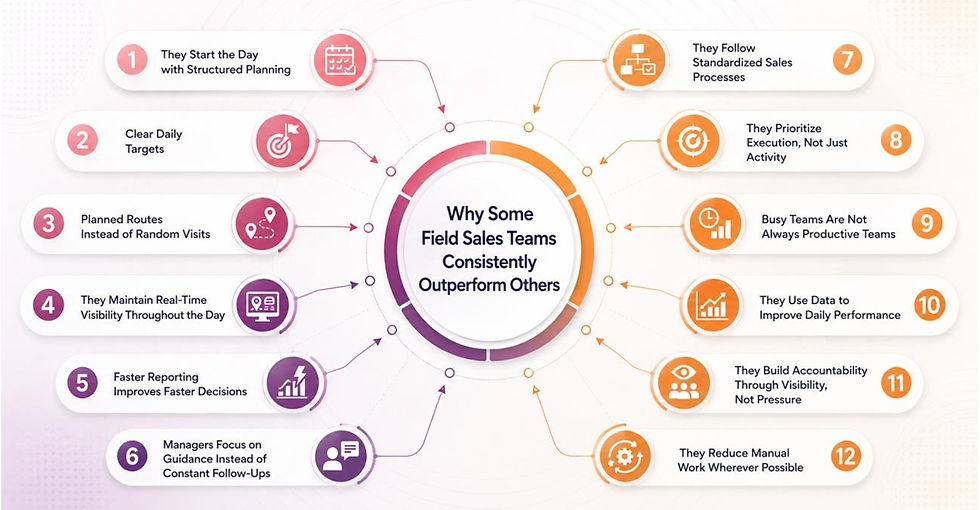
1. They Start the Day with Structured Planning
Field sales performance is rarely accidental. Consistently productive teams usually follow structured operational processes every single day. They do not depend entirely on individual working styles or manual coordination.
Instead, they build systems that make execution easier, reporting faster, and decision-making clearer. This creates consistency across the entire sales operation.
As teams grow larger, operational discipline becomes even more important.
Top-performing field sales teams do not enter the market without a plan.
Their day usually starts with structured field execution planning. This includes beat planning, territory allocation, retailer prioritization, visit scheduling, and route planning.
Structured planning also reduces unnecessary travel, duplicate visits, low-priority retailer visits, and wasted working hours.
2. Clear Daily Targets
High-performing teams operate with clear expectations. Sales reps know how many visits they need to complete, which retailers require priority attention, what follow-ups are pending, and what sales targets they are expected to achieve.
This improves execution consistency across the team. Instead of reacting randomly throughout the day, teams work with clear operational direction.
3. Planned Routes Instead of Random Visits
Top-performing teams use planned routes and structured beat coverage to improve territory utilization, travel efficiency, market coverage, and daily productivity.
Better route planning means more productive retailer interactions within the same working hours.
4. They Maintain Real-Time Visibility Throughout the Day
One of the biggest differences between average and high-performing field sales teams is visibility. Successful sales operations do not wait until the end of the day to understand what happened in the market.
Managers can track activity in real time like live visit reporting, GPS-based movement visibility, order updates, retailer interactions, and team activity tracking.
5. Faster Reporting Improves Faster Decisions
Delayed reporting creates delayed action. When managers receive updates at the end of the day, operational problems are discovered too late.
This affects missed retailer visits, low coverage, delayed collections, weak execution, and productivity gaps. Real-time reporting allows businesses to identify issues early and respond faster.
6. Managers Focus on Guidance Instead of Constant Follow-Ups
High-performing teams reduce dependency through visibility systems. When managers already have access to live activity updates, they can focus more on coaching, problem-solving, territory improvement, and execution support. This creates a healthier and more productive management environment.
7. They Follow Standardized Sales Processes
High-performing field sales teams usually follow consistent workflows. Their execution process is structured. Structured processes make performance more measurable and scalable. This becomes especially important when businesses expand their field teams across multiple regions.
8. They Prioritize Execution, Not Just Activity
Busy teams are not always productive teams. This is one of the biggest misconceptions in field sales management. Some teams appear highly active because they move constantly throughout the day.
High-performing teams focus more on execution quality. They prioritize meaningful retailer interactions, planned follow-ups, outlet servicing quality, order conversion, and territory effectiveness. Their goal is not just to stay busy. Their goal is to improve productive outcomes.
9. Busy teams aren't always the most productive teams.
High-performing sales teams focus on meaningful activities rather than simply staying busy. Instead of spending hours on manual reporting, administrative tasks, or chasing scattered information, they prioritize customer interactions, strategic follow-ups, and revenue-generating opportunities.
By streamlining routine work with the right tools and processes, they spend more time selling and less time managing operations—leading to better performance and more consistent results.
10. They Use Data to Improve Daily Performance
High-performing sales teams rely heavily on operational visibility. They use data to improve daily execution decisions. Not in a complicated way. But in a practical operational way.
This helps managers identify low-performing territories, underutilized routes, productivity gaps, and execution problems early. Data-supported field sales operations reduce guesswork. This improves both productivity and accountability.
11. They Build Accountability Through Visibility, Not Pressure
Many companies try to improve sales performance using pressure alone. But pressure without visibility usually creates frustration. High-performing teams build accountability differently. They create transparent operational systems.
This reduces excessive micromanagement. Sales reps know expectations clearly. Managers know what is happening operationally. That clarity improves trust across the team.
12. They Reduce Manual Work Wherever Possible
Manual work slows down field productivity. This creates operational delays and unnecessary admin work. Sales reps spend time updating reports instead of focusing on selling activities.
They automate repetitive operational tasks like visit reporting, order updates, attendance tracking, and activity logging. This creates more selling time during the day. It also improves reporting accuracy and operational visibility.
Operational Habits That Separate High-Performing Teams
Here are some common operational habits seen in consistently productive field sales teams:

But together, they create stronger execution consistency across the entire field operation. Over time, this operational discipline compounds into better sales productivity.
How Modern Field Sales Systems Support High Performance
As field operations become larger and more complex, manual coordination becomes difficult to manage. This is where modern field sales systems help businesses improve operational control.
Platforms like FieldTrix support high-performing field sales operations by helping businesses improve real-time visibility, simplify reporting, organize beat planning, track execution quality, monitor team productivity, and reduce operational delays.
The goal is not just automation. The goal is creating structured daily execution.
When managers gain operational clarity, teams can work more efficiently with fewer coordination gaps. This creates a more scalable sales operation.
Instead of depending entirely on manual supervision, businesses can build systems that support consistency across the field team.

The Future of High-Performance Field Sales Teams
Field sales operations are becoming more data-driven and visibility-focused.
Businesses are moving away from delayed reporting, manual coordination, and disconnected communication systems.
The future of high-performing field sales teams will depend heavily on:
Mobile-first operations,
Real-time execution visibility,
Smarter territory planning,
Automation,
And faster decision-making.
As competition increases, businesses that improve operational efficiency will gain a stronger advantage.
The companies that scale successfully will not simply push teams harder.
They will build better operational systems.
Conclusion
Top-performing field sales teams do not succeed only because of talent, motivation, or pressure. They succeed because their operations are structured. Their planning is disciplined. Their reporting is visible. Their execution is consistent. And their managers maintain operational clarity throughout the day. Over time, these operational habits create sustainable sales productivity. That is what truly separates high-performing field sales teams from struggling ones.
Final Thoughts
If your field sales team struggles with:
inconsistent reporting,
low visibility,
missed follow-ups,
productivity gaps,
or operational confusion,
The issue may not be effort alone. It may be the operational structure supporting your team.
Modern field sales systems like FieldTrix help businesses simplify field operations, improve visibility, and create more disciplined execution across sales teams. Because high-performing field sales teams are not built through daily firefighting.
They are built through operational consistency.